Helping Nonprofit Organizations Understand Cyber Risk, Strengthen Everyday Defenses, and Prepare to Respond with Confidence
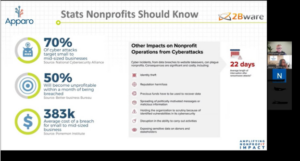
Cybersecurity Stats Nonprofits Should Know
Guest Writer Christopher L. Jones is a business consultant and cybersecurity professional with over 25 years of IT experience and 12 years of dedicated Cybersecurity experience. He is currently the Chief Cyber Strategist with 2Bware, LLC.
A recap of my May 6, 2026 Apparo webinar designed to help nonprofit organizations understand cyber risk, strengthen everyday defenses, and prepare to respond with confidence.
On May 6, 2026, I had the pleasure of presenting Cybersecurity Foundations 101 in a webinar hosted by Apparo for nonprofit leaders participating in a Technology Foundations cohort funded by MetLife. The session was created to make cybersecurity more approachable, practical, and actionable for organizations that are focused on serving their communities. Together, we explored the real risks nonprofits face, the tactics cybercriminals use, and the foundational steps leaders can take right now to better protect their people, data, and mission.
For many nonprofit organizations, cybersecurity can feel overwhelming or easy to postpone in the face of competing priorities. But the reality is clear: protecting systems, information, and operations is essential to sustaining trust and continuity. Whether an organization manages donor records, financial data, case information, or internal communications, even a single incident can create costly disruption. That is why this webinar focused on giving nonprofit leaders a strong foundation they can use to make informed decisions and move forward with greater confidence.
What We Covered in the Session
The webinar began with a simple but important message: nonprofit leaders need to be aware. Cyber threats are not limited to large enterprises with massive budgets and complex infrastructure. Nonprofits are often targeted because they operate with lean teams, limited resources, and fast-moving, trust-based communication. Building awareness at the leadership level is one of the most effective ways to improve decision-making around policies, training, technology, and preparedness.
We also examined the growing challenge of nonprofits vs. criminals. While nonprofit organizations are driven by service and impact, cybercriminals are driven by opportunity. That difference matters. Attackers look for weak points, and organizations of every size are at risk. By looking at the broader threat environment and the statistics behind modern cybercrime, the session reinforced an important truth: being mission-driven does not make an organization immune, but being informed can make it more resilient.
A key focus of the session was understanding how attacks happen and what they can lead to. We discussed phishing, spear-phishing, SMS or text phishing, and malicious QR codes, all of which are designed to create trust, confusion, or urgency in order to prompt risky actions. Those actions can quickly lead to malware, ransomware, or a data breach. For nonprofit leaders, understanding this progression is critical because it highlights how small moments of vulnerability can turn into major operational and reputational consequences.
Tactics, Techniques and Procedures Used by the Bad Guys
We also explored the tactics, techniques, and procedures used by bad actors. Cybercriminals frequently rely on impersonation, social engineering, urgency, and repetition to manipulate people into responding quickly instead of carefully. They may pose as executives, coworkers, vendors, or trusted organizations. Recognizing these patterns is essential for building a culture of caution, verification, and reporting—one where staff feel empowered to pause and confirm before taking action.
Practical Strategies You Can Use
Just as importantly, the webinar emphasized practical protection strategies that organizations can start using immediately. Strong cybersecurity is built through consistent, repeatable habits: regular awareness training, multi-factor authentication, timely software updates, access controls, reliable backups, and clear verification processes for unusual requests. Password best practices remain a core part of that foundation as well. Long, unique passwords and the use of a password manager can significantly reduce risk and improve everyday security across the organization.
Cyber-Resilience
One of the most encouraging themes in the webinar was that nonprofits can fight cybercrime too. Meaningful progress does not require a huge budget or a large internal security team. It starts with awareness, leadership support, practical safeguards, and a commitment to preparedness. We also discussed response and recovery, including the importance of knowing who to contact, how to contain an incident, how to communicate clearly, and how to restore critical operations as effectively as possible. Preparation makes resilience possible.
Cybersecurity is not just a technology issue—it is a mission issue. When nonprofit leaders understand the risks, recognize common attack methods, and invest in foundational safeguards, they put their organizations in a stronger position to protect the people and communities they serve. I was grateful for the opportunity to share this session through Apparo and to contribute to an important conversation about nonprofit resilience. For organizations looking for practical next steps, the National Cybersecurity Alliance also offers free awareness materials that can help support staff education and ongoing security efforts. If your organization is looking to strengthen its cybersecurity foundation, this is the right time to start.
For more information strengthening your nonprofit’s cyber‑resilience with Apparo Expert Link partners like 2Bware, please reach out to nonprofits@apparo.org.