Rising Needs, Shrinking Funding, and the Fight for Our Communities
By Kim Lanphear
Recent major funding cuts from changes to the tax codes, executive orders, and tariff effects have shuffled our philanthropic landscape. It is important that as businesspeople and citizens, we understand the dynamics that are shifting for all nonprofits across our communities. Soon, we will see a dramatic decline in the effectiveness of our social safety nets in serving the needs of our most vulnerable.
With basic needs funding decreasing from our federal government, and needs rising, those nonprofits providing the services need to turn to individuals, local governments, private foundations, and corporations to fill the funding gap. And the money is simply not there.
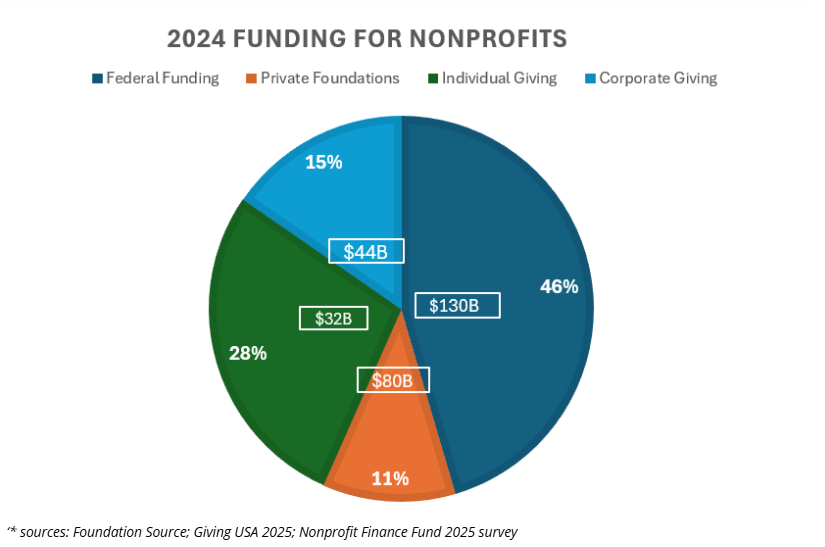
Because it makes up nearly half of all nonprofit funding, cuts to Federal Funding leave a huge services funding gap that is difficult for other sources to fill. Private Foundation funding is not expected to grow, and most have fairly inelastic funding amounts. While donations from individuals have been steadily increasing for the past years, they have declined in inflation-adjusted terms. Corporate giving grew 9.1% in 2024, representing $4 billion. Given the market constraints outlined below, corporate giving is not expected to continue growing in 2025. Mathematically, foundations, corporations and individual donations can’t make up for the loss of tens of billions in federal funding.
Here is a summary table of the federal funding dollars reduced for just food and housing insecurity needs in the first 6 months of 2025:
Summary Table (* ref. Congress.gov)
| Area | Federal Assistance Removed / Reduced |
| SNAP over 10 years | $186–200 billion in structural cuts |
| USDA Food Programs (2025) | $1 billion paused + $420 million canceled = $1.42 billion |
| Affordable Housing Contracts | $100 million canceled under the DOGE initiative |
| Rental Assistance | $26 billion restructured into block grants |
| HUD Disaster Grants | $314 million+ in jeopardy due to staff reductions |
While these dollars are being reduced, the need for these basic needs is rising and has been since 2022. The U.S. Department of Housing and Urban Development reported that homelessness rose by 18 % between 2023 and 2024, with nearly 771,480 people homeless on a given night in 2024—the highest ever recorded. A 2023 Feeding America survey found 65 % of food banks reported increased demand, with roughly 20 % more people served in late 2024 compared to 2023
The federal food and housing funding changes are heightening food and housing insecurity, shifting the burden onto nonprofits and local governments. As basic needs become forefront in hearts and minds, most other mission and social safety net programs (human trafficking, domestic violence, life-threatening disease support networks, special needs support, workforce development programs, reading and math support programs, addiction supports, mental health programs, etc.) are facing their funding being decreased or eliminated. As federally unfunded needs grow, nonprofits are forced to seek support from sources that once funded a broader range of missions, shifting attention away from diverse community programs and concentrating it on the most urgent crises.
Additional factors are exacerbating the problem. Supply chains are adding pressure with increased costs for lumber, healthy food choices, clothing, blankets, computers, paper, the basic minerals and metals to produce medical supply needs, and more. While the employment market adds more stress as companies lay off contractors no longer working with the government, researchers no longer funded at universities, and more, companies are tightening their corporate philanthropy giving. It is a perfect storm. More needs, fewer funding opportunities.
So, as you look across your community wondering where to help your fellow citizens in need, bear in mind that every single mission and safety net is being threatened. Your community social service safety net is in trouble, and the delivery of these services will likely have to be completely reimagined.